Weathering-mediated bedrock erosion

Summary: Tools for modeling the weathering-mediated erosion of bedrock. The focus is on environments with no soil or talus accumulation: for example, on steep bedrock channel walls.
Abstract
Weathering is an important process in bedrock river channels, but it receives less attention than on rockslopes and soil-mantled hillslopes. Sub-aerial weathering in particular weakens channel rock exposed during stage variation and makes it more susceptible to mechanical erosion. Such erosion modifies the depth-profile of rock weathering, which in turn modifies the process of weakening. Here we study how these interactions lead to a steady-state erosion rate.
Experiments indicate that rock weakness, defined as its propensity to erosion by flow-driven particle-impact wear, is inversely proportional to tensile strength squared, and that weathering-driven weakening takes place through wetting/drying, freeze/thaw and thermal cycling at rates that diminish in a roughly exponential fashion with depth.
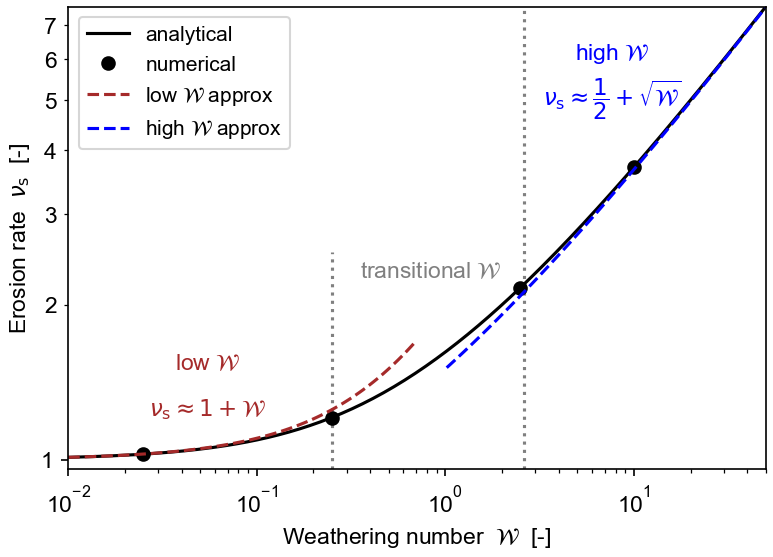
Such weakening propagates into the rock at a speed \({\lambda} {\eta_0}\), where \({\eta_0}\) is the weathering rate of fresh rock and \({\lambda}\) is the e-folding depth. The dimensionless ratio of this weakening speed to the speed of erosion of fresh rock \({u}_0\), which we call the weathering number \({\mathcal{W}}\), fundamentally controls model behavior.
For small \({\mathcal{W}}<0.25\) and slow weathering relative to erosion, the two speeds simply add and the erosion rate is approximately \({\lambda}{\eta_0} + {u_0}\). However, for \({\mathcal{W}} \gg 2.5\) and relatively fast weathering, the predicted behavior is counter-intuitive: the erosion rate is asymptotically the geometric mean of the two speeds \(\sqrt{ {\lambda} {\eta_0} {u_0} }\).
The rate of weathering alone never limits the rate of erosion, and so the concept of weathering limitation does not apply in the traditional sense.
Code
The code is provided as a Python package and Jupyter notebooks.
References
-
Inoue, T., Yamaguchi, S., and Nelson, J. M., 2017.. "The effect of wet-dry weathering on the rate of bedrock river channel erosion by saltating gravel", Geomorphology, 285, 152–161.
-
Li, K., Ma, L., Li, X., and Peng, S., 2016. "Effect of drying-wetting cycles on triaxial compression mechanical properties of sandstone", Journal of Engineering Science and Technology Review, 9, 66–73.
-
Stark, C.P., and Stark, G.J., 2022. "The direction of landscape erosion", Earth Surface Dynamics, 10: 383-419.